Species
Below is an indexed list of many of the species that can be found in Dolestar.
Human
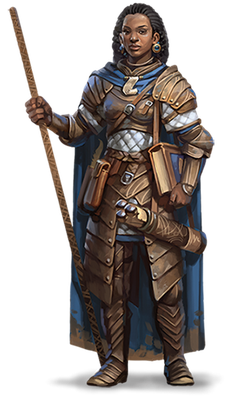
Humans are as varied as they are numerous, and they endeavor to achieve as much as they can in the years they are given. Their ambition and resourcefulness are commended, respected, and feared throughout the world. Humans are as diverse in appearance as the people of Earth.
.
.
.
.
.
.
.
.
.
.
.
.
Elf
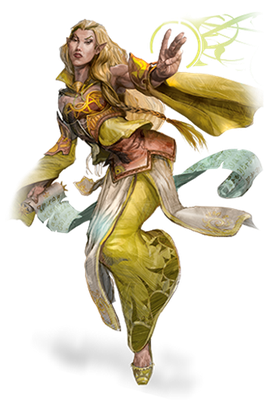
With their unearthly grace and fine features, elves appear hauntingly beautiful to humans and members of many other races. They are slightly shorter than humans on average, ranging from well under 5 feet tall to just over 6 feet. They are more slender than humans, weighing only 100 to 145 pounds. Males and females are about the same height, and males are only marginally heavier than females.
Elves' coloration encompasses the normal human range and also includes skin in shades of copper, bronze, and almost bluish-white, hair of green or blue, and eyes like pools of liquid gold or silver. Elves have no facial and little body hair. They favor elegant clothing in bright colors, and they enjoy simple yet lovely jewelry.
.
.
.
Dwarf
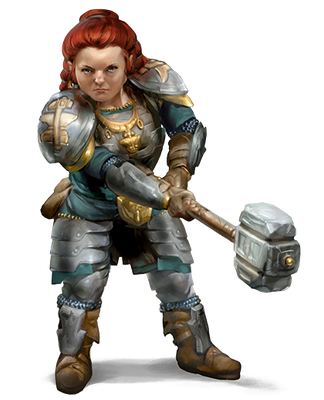
Bold and hardy, dwarves are known as skilled warriors, miners, and workers of stone and metal. Though they stand well under 5 feet tall, dwarves are so broad and compact that they can weigh as much as a human standing nearly two feet taller. Their courage and endurance are also easily a match for any of the larger folk.
Dwarven skin ranges from deep brown to a paler hue tinged with red, but the most common shades are light brown or deep tan, like certain tones of earth. Their hair, worn long but in simple styles, is usually black, gray, or brown, though paler dwarves often have red hair. Male dwarves value their beards highly and groom them carefully.
.
.
Halfling
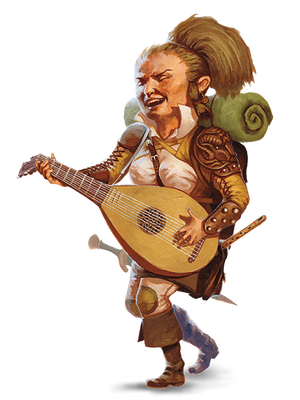
The diminutive halflings survive in a world full of larger creatures by avoiding notice or, barring that, avoiding offense. Standing about 3 feet tall, they appear relatively harmless and so have managed to survive for centuries in the shadow of empires and on the edges of wars and political strife. They are inclined to be stout, weighing between 40 and 45 pounds.
Halflings' skin ranges from tan to pale with a ruddy cast, and their hair is usually brown or sandy brown and wavy. They have brown or hazel eyes. Halfling men often sport long sideburns, but beards are rare among them and mustaches even more so. They like to wear simple, comfortable, and practical clothes, favoring bright colors.
Halfling practicality extends beyond their clothing. They're concerned with basic needs and simple pleasures and have little use for ostentation. Even the wealthiest of halflings keep their treasures locked in a cellar rather than on display for all to see. They have a knack for finding the most straightforward solution to a problem, and have little patience for dithering.
Gnome
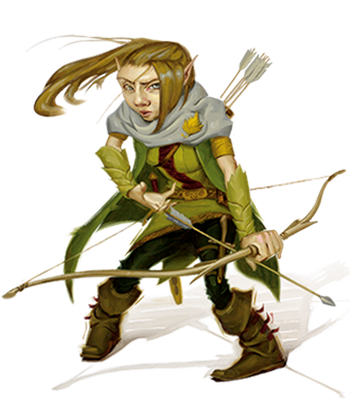
A gnome's energy and enthusiasm for living shines through every inch of his or her tiny body. Gnomes average slightly over 3 feet tall and weigh 40 to 45 pounds. Their tan or brown faces are usually adorned with broad smiles (beneath their prodigious noses), and their bright eyes shine with excitement. Their fair hair has a tendency to stick out in every direction, as if expressing the gnome's insatiable interest in everything around.
A gnome's personality is writ large in his or her appearance. A male gnome's beard, in contrast to his wild hair, is kept carefully trimmed but often styled into curious forks or neat points. A gnome's clothing, though usually made in modest earth tones, is elaborately decorated with embroidery, embossing, or gleaming jewels.
Tiefling
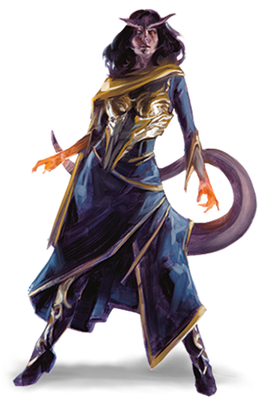
Tiefiings are derived from human bloodlines, and in the broadest possible sense, they still look human. However, their infernal heritage has left a clear imprint on their appearance. Tiefiings have large horns that take any of a variety of shapes: some have curling horns like a ram, others have straight and tall horns like a gazelle's, and some spiral upward like an antelopes' horns. They have thick tails, four to five feet long, which lash or coil around their legs when they get upset or nervous. Their canine teeth are sharply pointed, and their eyes are solid colors-black, red, white, silver, or gold-with no visible sclera or pupil. Their skin tones cover the full range of human coloration, but also include various shades of red. Their hair, cascading down from behind their horns, is usually dark, from black or brown to dark red, blue, or purple.
.
.
.
Aasimar
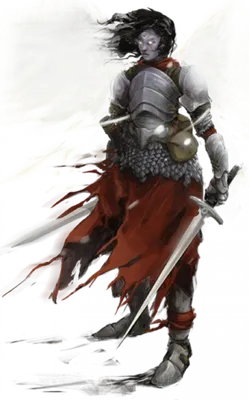
Aasimar (pronounced AH-sih-mar) are mortals who carry a spark of the Upper Planes within their souls. Whether descended from an angelic being or infused with celestial power, they can fan that spark to bring light, healing, and heavenly fury.
Aasimar can arise among any population of mortals. They resemble their parents, but they live for up to 160 years and have features that hint at their celestial heritage, such as metallic freckles, luminous eyes, a halo, or the skin color of an angel (silver, opalescent green, or coppery red). These features start subtle and become obvious when the aasimar learns to reveal their full celestial nature.
.
.
.
.
.
Dragonborn
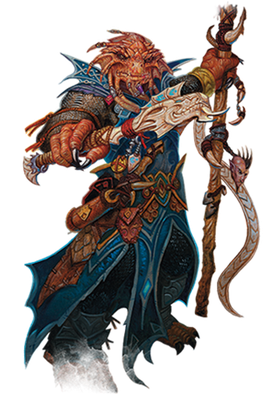
Dragonborn look like wingless, bipedal dragons— scaly, bright-eyed, and thick-boned with horns on their heads— and their coloration and other features are reminiscent of their draconic ancestors.
.
.
.
.
.
.
.
.
.
.
.
.
.
.
Goliath
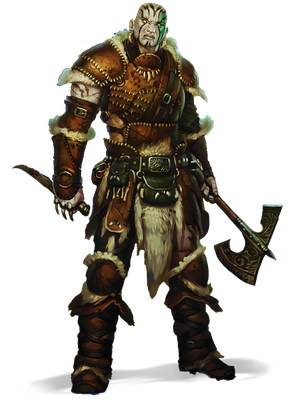
The first goliaths lived on the highest mountain peaks- far above the tree line, where the air is thin and frigid winds howl. Distantly related to giants and infused with the supernatural essence of their ancestors' mountainous home, goliaths stand between 7 and 8 feet tall and have a wide array of skin tones resembling different types of stone.
.
.
.
.
.
.
.
.
.
.
Firbolg
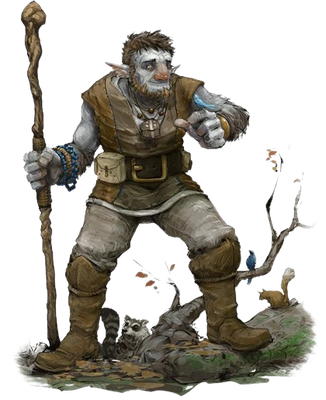
Distant cousins of giants, the first firbolgs wandered the primeval forests of the multiverse, and the magic of those forests entwined itself with the firbolgs' souls. Centuries later, that magic still thrums inside a firbolg, even one who has never lived under the boughs of a great forest.
A firbolg's magic is an obscuring sort, which allowed their ancestors to pass through a forest without disturbing it. So deep is the connection between a firbolg and the wild places of the world that they can communicate with flora and fauna. Firbolgs can live up to 500 years.
.
.
.
.
.
Genasi
.
.
.
.
.
.
.
.
.
.
.
.
.
.
.
.
.
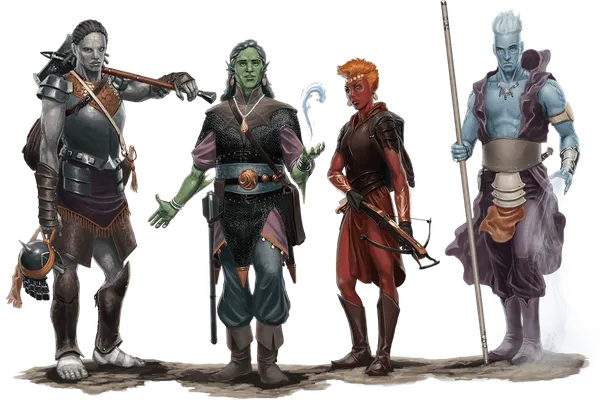
Tracing their ancestry to the genies of the Elemental Planes, each genasi can tap into the power of one of the elements. Air, earth, fire, and water-these are the four pillars of the Material Plane and the four types of genasi. Some genasi are direct descendants of a genie, while others were born to non-genasi parents who lived near a place suffused by a genie's magic.
A typical genasi has a life span of 120 years.
Changeling
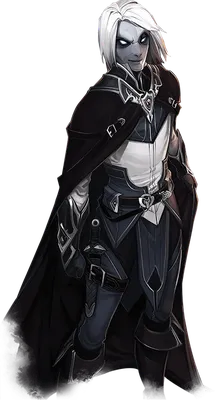
In their true form, changelings are pale, with colorless eyes and silver-white hair. It is rare to see a changeling in that form, for a typical changeling changes their shape the way others might change clothes. A casual shape— one created on the spur of the moment, with no depth or history— is called a mask. A mask can be used to express a mood or to serve a specific purpose and then might never be used again. However, many changelings develop identities that have more depth. They build an identity over time, crafting a persona with a history and beliefs. This focused identity helps a changeling pinpoint a particular skill or emotion. A changeling adventurer might have personas for many situations, including negotiation, investigation, and combat.
Personas can be shared by multiple changelings; there might be three healers in a community, but whoever is on duty will adopt the persona of Tek, the kindly old medic. Personas can even be passed down through a family, allowing a younger changeling to take advantage of contacts established by the persona's previous users.
Goblin
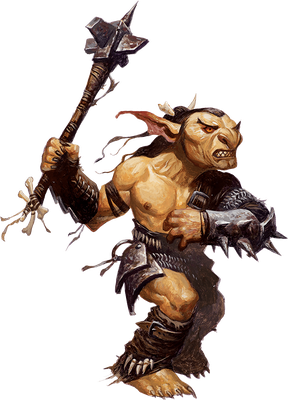
A subterranean folk, goblins can be found in almost every corner of the continent, often beside their bugbear and hobgoblin kin. Early goblins lived in the Feywild, but for reasons unknown ventured forth to the Material Plane en masse. Goblins thrive in this dangerous world thanks to a special boon— a supernatural knack for finding the weak spots in foes larger than themselves and for getting out of trouble.
.
.
.
.
.
.
.
.
.
.
Orc
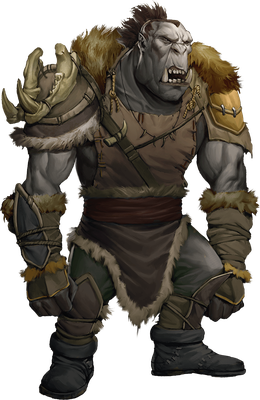
Orcs are, on average, tall and broad. They have gray skin, ears that are sharply pointed, and prominent lower canines that resemble small tusk. Orc youths are told about their ancestors' crreat travels a11d travails. Other orcs are happy to leave old tales in the past and find their own way.
Many orc traits make them quite adept at traveling through the dangerous lands of Dolestar. Endurance, determination, and grit are some of the keystones orc culture.
.
.
.
.
.
.
.
.
.
.
Plasmoid
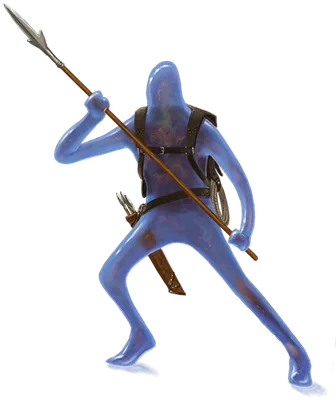
Plasmoids are intelligent oozes that can alter their shape at will. Their amorphous bodies have a soft, malleable texture, and plasmoids can extrude up to five pseudopods, each one up to 5 feet long. They use their pseudopods for locomotion as well as for manipulating objects.
Every plasmoid has a mass of nerves for a brain. Plasmoids don't have internal organs as humans know them, but they have pores through which they absorb oxygen. Up to four times in its life, a plasmoid can reproduce by joining with another member of its species. After this merging, the two plasmoids separate, and one of them (determined randomly) divides in half. When a plasmoid splits in two, one of the resulting creatures is the original, and the other is a physical duplicate that lacks the experience and knowledge of its parent.
A plasmoid talks by forcing air through tubular cavities in its body, giving its voice a whistling quality.
Warforged
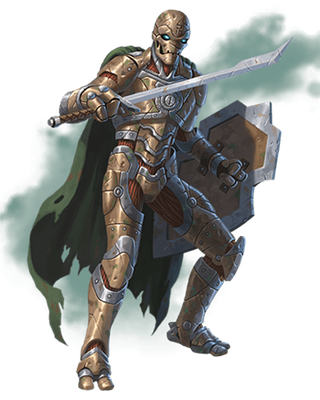
Built to fight in a long-forgotten war, warforged are formed from a blend of organic and inorganic materials. Root-like cords infused with alchemical fluids serve as their muscles, wrapped around a framework of steel, darkwood, or stone. Armored plates form a protective outer shell and reinforce joints. The precise materials and build of a warforged vary based on the purpose for which it was designed.
Although they were originally manufactured, warforged are living humanoids. Resting, healing magic, and the Medicine skill all provide the same benefits to warforged that they do to other humanoids.